
Read Clark County Deed Records
Clark County deed records capture every written instrument that moves, limits, or clarifies an interest in land. Search Clark County deeds by grantor or grantee. Then tie each hit to the legal description and recording reference. A current parcel entry offers a starting owner of record and a land clue. The deed chain itself lives with the county recorder. Older work may run through books, microfilm, plats, and state archive holdings. Deeds share the index with many related instruments. So a careful search also covers releases, easements, affidavits, surveys, and court-linked filings.
| Deed Type | What It Does | Common Use |
|---|---|---|
| Warranty deed | Conveys the stated interest with deed warranties | Ordinary voluntary transfers |
| Quitclaim deed | Conveys whatever interest the grantor holds | Interest cleanup or intra-family transfer |
| Executor or administrator deed | Conveys through an estate representative | Probate-related transfer |
| Sheriff's deed | Records a transfer following a completed legal sale process | Foreclosure or other court sale |
| Correction instrument | Addresses an error or omission in an earlier filing | Name or description correction |
The Register indexes far more than deeds. Mortgages, releases, assignments, easements, plats, surveys, affidavits, powers of attorney, UCC filings, and oil, gas, or wind instruments may all explain the same property story. A mortgage or easement can burden land without changing the owner of record. A release clears an encumbrance rather than transferring title.
Clark Deeds Start at 913 Highland
Head to the Clark County Register of Deeds at 913 Highland in Ashland. The office runs two public kiosks plus an in-house digital search system. Its public pages advertise no complete remote grantor-grantee interface or a reliable hours statement. Call 620-635-2812 before visiting.
Document scanning started in 2005 with Document Pro. The in-house search system dates to 2021. Those years describe image management, not the earliest deed year. Nor do they show how far a complete online index reaches. Ask staff which index covers your date. Also ask whether the record sits in digital form, on microfilm, or in a book.
The official Register of Deeds page lists the office's instruments and access details.
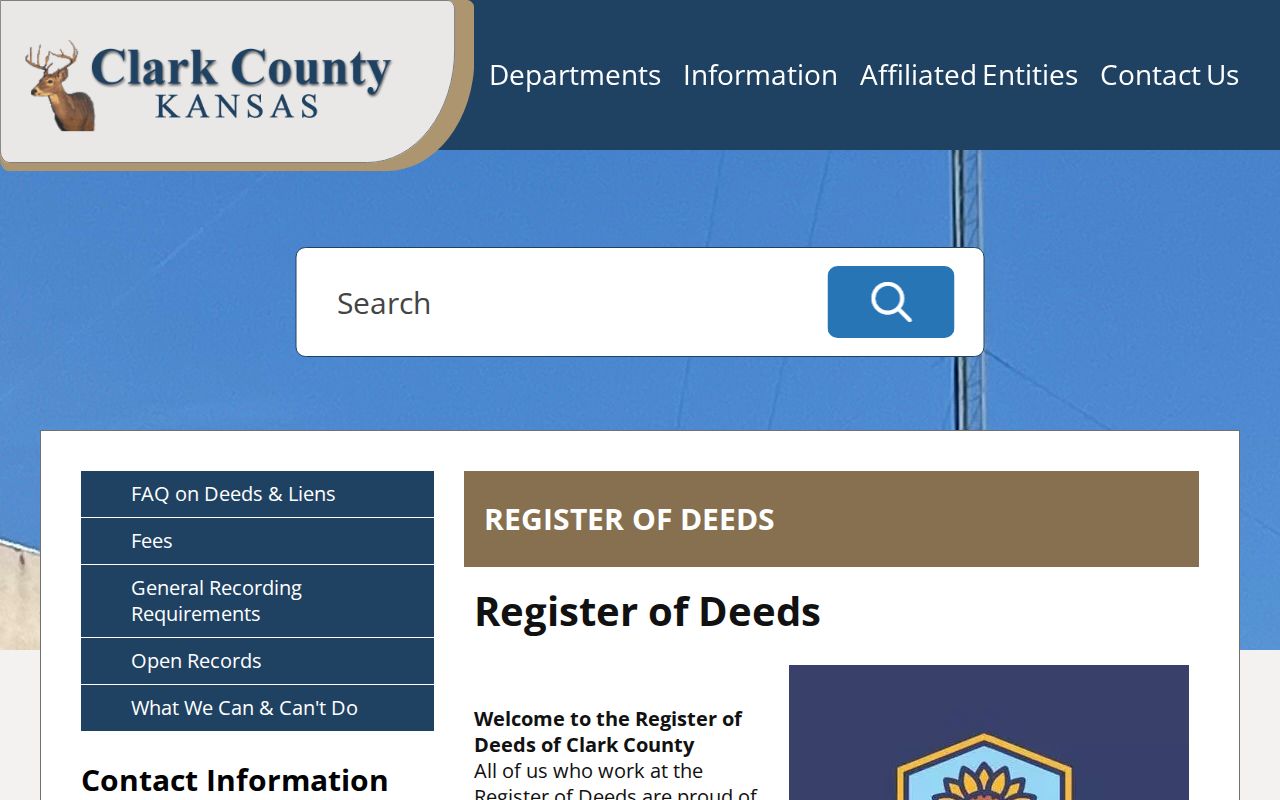
The office's official page helps you tell the county custodian apart from commercial deed-search results that often omit local access limits.
Follow Clark's Grantor-Grantee Index
The grantor-grantee index sorts parties by role. A grantor conveys the stated interest; a grantee receives it. To trace Clark County deed records backward, start with the latest verified grantee. Use the legal description too. Then search that grantor as an earlier grantee. Matching the land matters, since one person or entity can appear in unrelated transactions.
- Use the parcel system to obtain the exact legal description and current indexed name.
- Find the newest matching instrument and read its grantee, grantor, date, and reference.
- Search the grantor as a grantee in an earlier period and match the same land.
- Check later corrections, probate instruments, court filings, releases, and easements.
- When the digital index ends, continue in the proper reverse index, deed book, or microfilm.
- Grantor
- The party conveying an interest under the recorded instrument.
- Grantee
- The party receiving the interest described by the instrument.
- Chain of title
- The connected sequence of instruments affecting ownership of the same land.
- Book and page
- A volume reference used to retrieve an older recorded document.
Clark Deeds Follow Land Descriptions
Clark County's recording requirements put the legal description at the heart of deed research. Platted land should name lot, block, number, division, subdivision, and town. Unplatted land relies on section, township, range, and quarter details. Signatures need proper notarization, and the original must be legible enough to reproduce.
A street address can point to a likely assessment parcel. But old deed records may not include one. Street names, directional prefixes, and town references all change over time. Copy every fraction and exception from the deed. A parcel ID is only a search key. It is never a substitute for the text defining the conveyed land.
Older Clark Deed Records
The earliest searchable index year is not published. The archive fallback is therefore part of the normal deed route. It is not an edge case. Permanent series include deeds, grantor-grantee indexes, mortgages, plats, leases, and patent records. For a date outside the digital system, the Register can identify the volume needed. It can also point to the right index or microfilm.
The Kansas Historical Society land collection adds tract books, survey plats, and microfilm. It also holds some unindexed FamilySearch images. Tract books may reveal an original purchaser or grantee, acreage, price, date, and legal location. Search them by section-township-range or a precise book and page. Then turn to county deeds for later transfers.
Clark's 1909 Ownership Map
Dick Mackey's 1909 Plat Book of Clark County, Kansas preserves a period view of rural owner names, roads, schools, and churches. It also shows the cemeteries. It can orient a deed chain when modern addresses fail to match the historic account. Treat the map as context, not a replacement for a recorded deed or survey.
Minneola's railroad lots can leave a gap between a current address and an old description. So can Englewood's depot corridor. Ashland's moved buildings and its 1933 downtown fire do the same. Each is a prompt to inspect plats, rights-of-way, and deeds. The fire does not mean Clark County deed books were destroyed.
Some Clark Records Stay Restricted
The Kansas Open Records Act sets the rule. The Register's open-records page treats nearly all records as open during regular business hours. Two exceptions stand out. Kansas Real Estate Sales Validation Questionnaires and military discharge records are limited to authorized persons. Public indexing does not make every related form open for copying.
A narrow KORA request can seek an existing record by parcel or legal description. It can also narrow the ask by instrument type, party, and date range. Kansas generally demands a response as soon as possible. It must come by the close of the third business day. Otherwise the office sends an explanation of delay, a lawful denial, or expected fees. That rule never obliges the office to research title or produce a legal opinion.
Request Clark County Deed Copies
Start with the details that identify the deed. Give the Register the grantor and grantee names, an approximate date, the legal description, the deed type, and any book, page, or filing reference. More precision means fewer dead ends. Access runs through two public kiosks, staff-assisted help at the office, a phone inquiry, or a focused written public-record request. The county publishes no open remote deed images.
The posted fee schedule carries a July 1, 2014 effective date and lists recording and copy amounts, including a certified-instrument charge. Those figures age. Confirm current plain-copy, certification, staff-time, mailing, and payment terms with the office before relying on them. Recording fees and copy charges are distinct under KORA.
Recorded, not guaranteed. Clark County deed records show accepted filings. They do not guarantee clear title, resolve every unrecorded interest, or replace a professional title search.
Deed Records Need Cross-Checks
The Register does not run title searches. A full title exam reaches beyond the deed books. An examiner may need county deeds, District Court and probate files, federal court records, liens, releases, easements, and legal descriptions. Real-property mechanics liens are filed in District Court. Personal-property UCC filings, by contrast, move through a different filing path entirely.
Kansas CaseSearch offers a docket lead for foreclosure, probate, quiet-title, boundary, or mechanics-lien matters. Some papers still live only on courthouse terminals or in response to requests. Then return to the Register. The recorded lis pendens, sheriff's deed, order-related instrument, satisfaction, or later transfer is what ties the court case back to the land.
Encumbrances run on their own track. A mortgage creates an interest distinct from a deed. An assignment shifts the mortgage holder without releasing it. Hunt for the satisfaction or release that cites the original reference before assuming the lien still stands. Easements can benefit one parcel while burdening another. Oil, gas, and wind instruments may involve leases, assignments, memoranda, pooling terms, or surface rights, all while the fee owner stays unchanged.
Mechanics liens show why one index never suffices. A real-property mechanics lien lands in District Court, while UCC filings for personal property take the other route. Read the docket and the recorded notice or release together, in context. A financing statement tied to a landowner is not automatically a lien on the land.
Estates complicate deed history too. A death certificate alone transfers nothing. The bridge is usually a recorded instrument: a probate order, executor's deed, affidavit of descent, survivorship instrument, transfer-on-death filing, trust instrument, or later deed. Compare the court file against the Register index and hold the legal description constant throughout. The assessment roll may show a later name update. That administrative change never substitutes for the recorded transfer.
Clark County publishes no official property-fraud alert signup. Skip third-party alert claims. The reliable check is periodic review of the Register index plus direct contact with the office. If an unfamiliar deed or signature shows up, preserve the official reference and date, request the instrument, and seek qualified title or legal advice.
Keep a reproducible log of every search. Record party spellings, roles, date spans, the legal description, each index consulted, and every book or file reference. File staff cross-references with the matching row. That discipline sorts a genuine gap from a spelling change, a partial conveyance, or a move between digital and bound indexes.