
Clark County Property Value Types
The Clark County Appraiser discovers, lists, and values taxable real and personal property. Its work starts with fair-market value as of January 1. Kansas class ratios turn that figure into assessed value. A recorded deed may supply a consideration or sale clue, while the Treasurer's bill reflects the tax base and levies. Keep each source attached to its date.
| Value | What It Is | Where |
|---|---|---|
| Appraised value | County estimate of fair-market value | Appraiser record |
| Assessed value | Appraised value after the statutory class ratio | Assessment roll |
| Sale consideration | Amount or consideration tied to a recorded transfer | Deed or transfer record |
| Tax amount | Charge after levies and tax treatment | Treasurer account |
Assessed value is not a second opinion on price. It is simply the appraised figure multiplied by the legal ratio. That ratio reflects the property's verified class. The tax bill sits another step beyond that. So a buyer should never stack a tax bill, an assessed value, and a deed's consideration. They were never meant to sit side by side. Each one was measured at a different time and for a different purpose.
Clark County Assessed Value Math
K.S.A. 79-1439 sets the Kansas assessment ratios. Residential property is generally assessed at 11.5 percent of fair-market value. Commercial and industrial property is generally 25 percent. Agricultural land uses a state use-value method and is assessed at 30 percent. Other classes carry their own statutory treatment.
The Kansas Department of Revenue value explanation gives the basic relationship: appraised value multiplied by the class percentage equals assessed value. Two Clark County properties can share the same appraisal yet show different assessed figures whenever their classes differ.
Ratio check. Confirm the parcel class before applying any percentage; a portal dropdown option alone does not establish a parcel's classification.
Clark County Market Value Factors
Under K.S.A. 79-503a, fair-market value is a reasoned estimate, never just the last sale price. The law points to classification, size, and location. It also weighs depreciation, replacement cost, productivity, income, sale evidence, restrictions, and comparable property. The Appraiser's real-estate page describes a broad evidence file. It covers ownership, location, use, sales, building measurements, construction details, rental data, subdivision maps, permits, contractor facts, and inspection material.
One sale helps. It is never the whole story. A family transfer, a partial interest, or an odd transaction may not reflect an open-market exchange. A deed with non-price terms may not reflect one either. Before treating a deed's consideration as the home's value, read the deed type and the legal description in the deed records carefully.
Clark County Value Calendar
Clark County sets its valuation clock by the property-tax calendar. January 1 is the valuation date. Change-of-value notices go out March 1, and a 30-day appeal window follows. That schedule explains a familiar quirk. The tax roll can trail a sale or a physical change by months, since values freeze on the first of the year.
The parcel form updates on Sundays. That cadence is a portal habit. It is not a pledge that every fresh deed or improvement shows up in the next refresh. Keep the valuation year, the search date, the notice, and the parcel number together. When a figure moves, ask what moved it. The cause could be annual review, new construction, corrected characteristics, a class change, or other supported appraisal evidence. The dollar amount alone never tells you the cause.
Note: A Sunday portal refresh and the annual appraisal cycle describe different kinds of currency in Clark County records.
Look Up Clark County Value
The public Aumentum form is the workhorse for a Clark County property search. It accepts an address-number range, street, ZIP, and owner. You can also search by parcel ID, quick ID, appraised-amount range, acreage, class, neighborhood code, section, township, and range. Physical and LBCS filters can narrow a candidate parcel nicely. Just remember they are database fields, not an appraisal inspection or a zoning ruling.
- Search the address or exact parcel ID and save the query date.
- Record the appraised value, assessed value, class, and year only if the returned card displays them.
- Use the legal description to check the latest recorded deed for sale or consideration context.
- Compare like years, classes, and property facts. Ask the Appraiser for supporting records when the public result is incomplete.
- Assessed value
- The appraised figure after the statutory class ratio.
- Fair-market value
- The county's estimate of an open-market value as of the valuation date.
- Assessment ratio
- The legal percentage used to convert appraised value into assessed value.
- Consideration
- The value or terms stated for a transfer, which may not equal open-market price.
Clark County Value Source
The Appraiser page is the anchor for Clark County property value definitions. It states the office's fair-market role plainly.
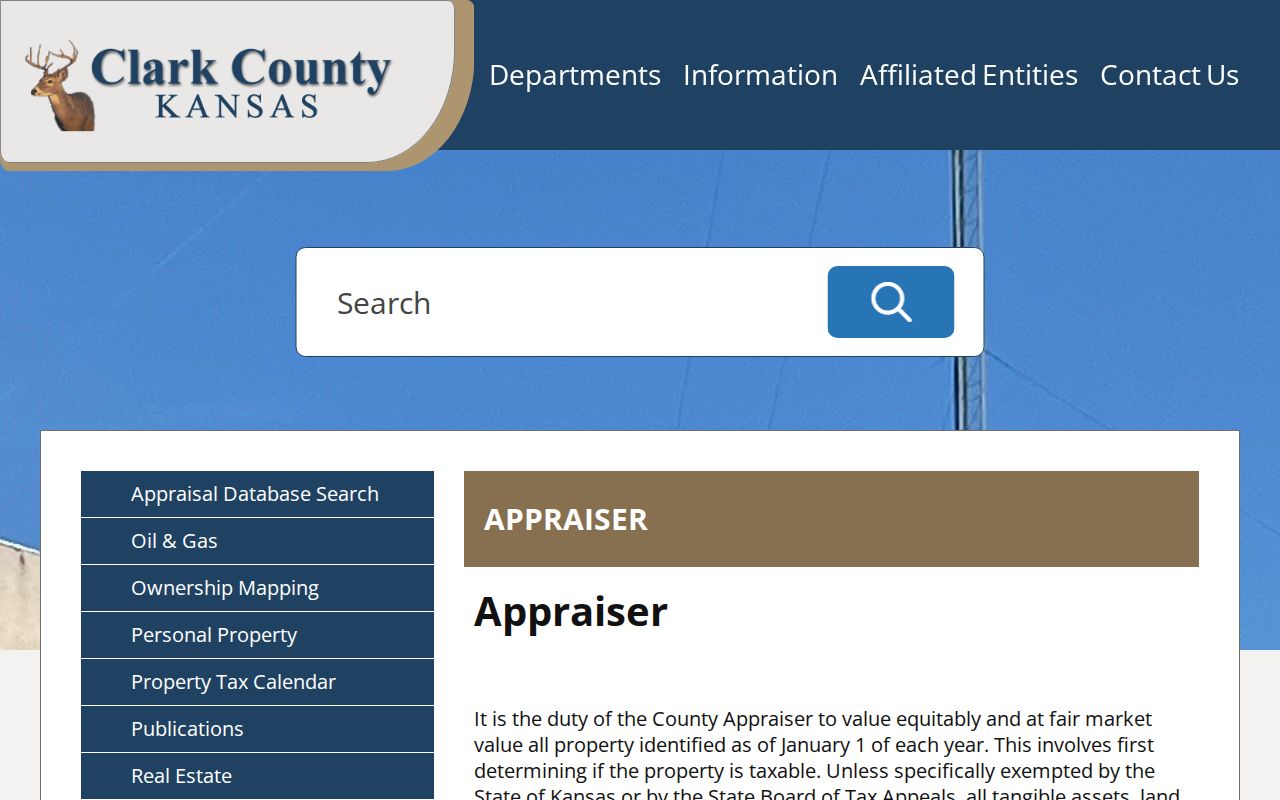
The page draws a clean line between the appraisal function and the taxing jurisdictions that set levies. The appraiser estimates value. The levy decisions belong elsewhere, which is why a high tax bill does not always mean a high appraisal.
Clark County Agricultural Value
Farm ground does not get valued the way a house lot does. Kansas appraises agricultural land on use value, not market value. The state agricultural valuation material spells out that distinction. Casual price comparisons will mislead you. A Clark County farm and a nearby residential tract sit on different yardsticks. A farm homesite is the acre around an actual dwelling. It can also carry its own class apart from the surrounding farmland.
The parcel form breaks classes out in detail. Agricultural Use and Farm Homesite appear as separate options. So do residential, commercial and industrial, exempt, vacant, utility, and other categories. Those filters help narrow a Clark County property search. They do not settle the question on their own. Check the returned parcel record and state rules before treating any tract as agricultural.
Clark County Sale Price Clues
Two Clark County offices split the work here. The Register of Deeds records instruments. The Appraiser collects sale data as one input into valuation. The Register also notes a restriction here. These Kansas Real Estate Sales Validation Questionnaires go only to authorized persons. A public deed can supply consideration context. A restricted questionnaire is not an open data source.
Before trusting a sale clue, match it to the land. The newest instrument's grantor, grantee, recording date, and deed type should line up with the parcel you are researching. The legal description should match too. Quitclaim, corrective, estate, survivorship, and similar transfers often do not reflect an ordinary market sale. The county performs no title search. That deeper step stays with you.
Clark County Value Limits
A county value exists for tax administration, not for private deals. It is no substitute for a sale appraisal. It is not a purchase offer, an insurance replacement figure, or a title opinion. Valuation dates stay fixed. Market conditions can shift long after that date passes. A licensed appraiser can inspect the assignment and develop an opinion for the stated purpose.
A tax account adds billing and payment facts, not market proof. For levies, exemptions, bills, delinquency, or appeals, the Clark County property tax records page covers the mechanics. Keep the valuation question separate from the amount due.
Value is not price. A Clark County assessed value serves taxation and does not predict what the property will sell for or replace an appraisal.
Clark County Value Record Access
Start with the online tools. When a sample card, a prior year, or supporting detail is missing, reach the Appraiser by phone, at the counter, or in writing. The office sits at 913 Highland in Ashland, and the phone number is 620-635-2142. The Register's public kiosks and office access supply deed context. The Treasurer handles bills and payment status.
A KORA request should name the parcel, the year, the record type, and the format you want. Under the Kansas Attorney General's guidance, agencies generally respond by the end of the third business day or explain any delay, cost, and expected timing. Reasonable actual fees may apply. Ask for existing valuation records, not a fresh appraisal or a legal opinion.
The Appraiser's valuation files draw on many sources. Deeds, subdivision maps, permits, contractor data, site inspections, sales, measurements, construction facts, and rental information all feed into them. A narrow request might target the property record card, the valuation notice, the classification, or other existing support for a stated year. When a public result omits a field, describe it as an access gap rather than promising the field appears.
Clark County's public parcel form carries a disclaimer about current and prior tax data. It updates on Sundays. Save that disclaimer with any value you keep. Two figures can differ for ordinary reasons. Check the valuation date, the tax year, the class, the parcel identity, and whether one figure is appraised while the other is assessed. Only then look for a correction or appeal record.
A value dispute runs on the notice calendar. Clark County sets change-of-value notices for March 1 and allows 30 days to appeal. Under Kansas appeal material, the county must produce its evidence and receives no automatic presumption that its value is correct. Keep the mailed notice. Photographs, correct building facts, comparable sales, surveys, permits, and restrictions all bear on value. The appeal turns on appraisal evidence. Payment and balance questions still belong to the Treasurer.
No live sample parcel card appears publicly. The search fields exist. The exact value-card layout, the current-owner display, and the lag between a recorded deed and the roll do not. Use the portal, note what actually appears, and contact the Appraiser when an expected field is absent.